
Introduction to our architecture
Quantum network architecture
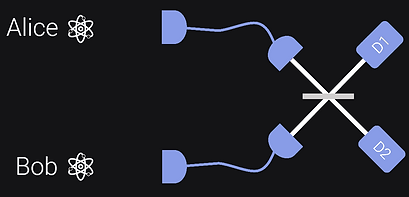
Entanglement generation between two separate ions via emitted photons.

High-NA lenses collect ~10% of the photons emitted by a single ion
Cavities have the potential to generate single photons with near-perfect efficiency
The high fidelity quantum gates and long coherence times achievable using trapped ions makes them an ideal platform for quantum computing. The principal scaling challenge now lies in managing trapped ion processor complexity. Quantum networks have the potential to overcome this, due to their distributed, modular design.
By utilising long range remote entanglement, separate ion trap ‘nodes’ can be connected. This is mediated via single photons collected from an ion in each node. Initially, the state of an ion in each node is entangled with the state of a photon emitted from the ion. This entanglement is then transferred to the ions, via entanglement swapping with a photonic Bell state analyser. By routing photons through photonic switches, links can be established between arbitrary node pairs and used to assemble complex entangled network states.
Entanglement rates of current ion trap networks are limited by photon collection efficiency. Most ion trap networks currently employ high numerical aperture lenses to collect single photons from ions, to be used for entanglement generation. We are instead employing optical cavities to aid in the production of single photons. These have the potential to increase collection efficiency by up to an order of magnitude versus current lens-based systems. By utilising cavity-based photon production, we aim to boost our remote ion-ion entanglement rate to 10-100 kHz, approaching that of local laser- and microwave-based entangling gates.